The Athenaeum Arts and Performance Complex

A gateway district at The University of Texas at Dallas

The Edith and Peter O’Donnell Jr. Athenaeum is a cultural hub at the University of Texas at Dallas, envisioned as both a gateway to the campus and a destination for the broader community. Set on 12 acres at the university’s southeastern edge, the Athenaeum brings together art, performance, and public space to foster learning, creativity, and engagement.

Designed by the architecture firm Morphosis, the district master plan includes three buildings organized around a central plaza: The Crow Museum of Asian Art, a music building with a 680-seat concert hall, and a future campus museum. Supported by a gift from the O’Donnell Foundation, the Athenaeum is unfolding in phases. The Phase I Crow Museum is now open to the public. Phase II, the Performing Arts Center and music education facility, will open in 2026.

Services

  • Branding and Identity
  • Experiential Design
  • Signage and Wayfinding

Project Team

  • Morphosis
  • GFF
  • The Beck Group
  • Project Control

Of light and shadow

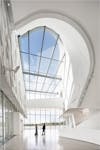
The buildings share a unified design language, volumes carved and sculpted from a single mass. Transparency plays a central role, with expansive glass connecting galleries and public spaces to the plaza and campus beyond, keeping culture and creativity visible at all times. The Crow Museum is defined by curved cast concrete panels detailed with geometric shapes that migrate into the lobby. Circulation and gallery spaces are activated by unexpected cuts of daylight. 

Identity conveys context

The Athenaeum’s visual identity distinguishes the district within the UT Dallas campus, while identifying its focus on the arts and acknowledging principal donors. The typography’s angular details are cut from the same progressive cloth as the building skin. 

Produced monochromatically, the structured wordmark respects its context with thoughtful restraint. A monument sign at the connecting point to the campus edge is a single cast of fine aggregate concrete that matches the building facade.

1/2

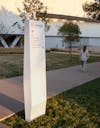
Site wayfindng

Monolithic pylons direct pedestrian and vehicular traffic, echoing the faceted forms of the surrounding architecture.

Exterior building signage

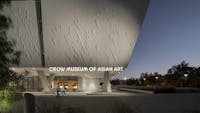
The primary building sign for the Crow Museum is composed of infinity-edge channel letters mounted flush to the façade. Internal illumination is calibrated to match the color temperature of the adjacent soffit lighting.

Interior signage

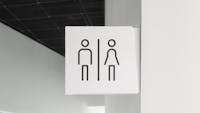
The signage voice is orderly and elegantly discreet. The push and pull of planes shape light and shadow, defining the design language. Forms, symbols, and typography speak quietly as one, understood without drawing attention from the work in the galleries. 

Custom symbols echo the curves and edges of the building while guiding visitors in a universal language.

Master plan rendering by Morphosis
Architectural photography by Mauricio Rojas, AIA
Signage photography by Kristian Alveo